
21st April, 2026 – Altilium, a UK-based clean technology company focused on sustainable recovery of critical battery materials, has today announced a strategic collaboration with The Structural Battery Company to develop a fully sovereign battery supply chain for next-generation drone technologies.
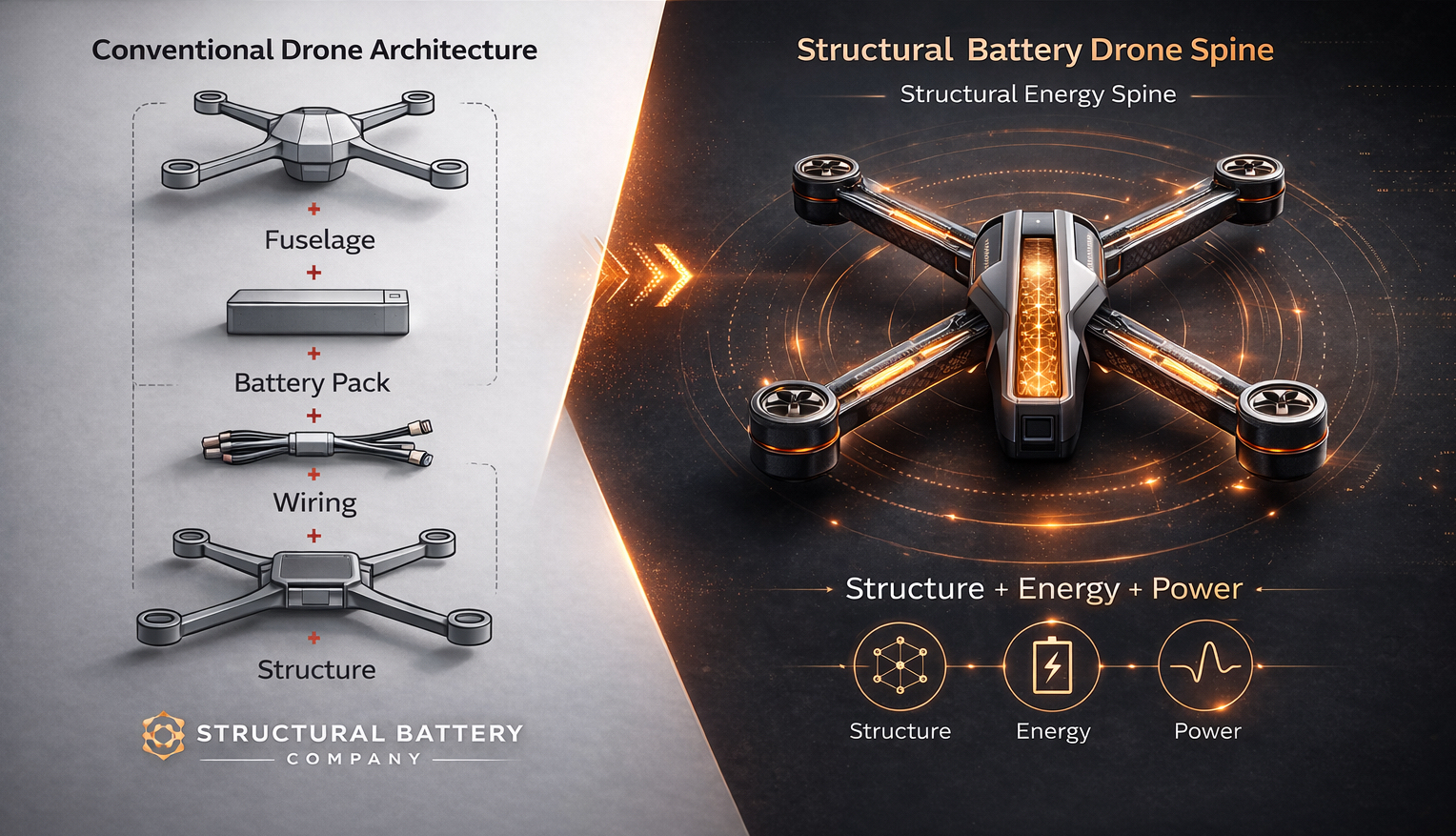
The collaboration will focus on integrating Altilium’s recycled battery materials, recovered from end-of-life EV batteries, into an advanced structural battery system developed by The Structural Battery Company for use in heavy-lift drones. The innovative design embeds energy storage directly into the airframe of the drone, enabling lighter, stronger and higher-performance drone platforms.
Together, the companies aim to demonstrate the concept of a “Total UK Drone Spine”, where both the structural components and battery materials are derived from domestically sourced and recycled critical minerals.
As the use of battery-electric heavy-lift drones becomes more widespread in logistics and defence, establishing a domestic supply of battery materials will be vital to ensure operational sovereignty and protection from future demand shocks.
Currently, the UK is reliant on international supply chains for battery materials such as lithium, nickel and graphite, leaving it vulnerable to supply disruptions and price increases. By recovering these critical materials from old EV batteries in the UK, Altilium is building a circular supply chain and helping to reduce reliance on imported materials.
Under the agreement, the two companies will explore the technical feasibility of producing battery cells with recycled cathode active materials (CAM) and anode active materials (AAM) for use within The SB Co’s Drone Spine technology, a structural battery backbone for heavy uncrewed aerial vehicles. By turning the battery from payload into primary structure, the technology reduces structural mass and provides greater mechanical strength, electrical performance and sustainability.
Dr Christian Marston, COO of Altilium, commented: “This collaboration represents an important step towards building a truly sovereign battery supply chain for the UK’s future logistics infrastructure. By combining recycled materials with cutting-edge structural battery technology, we’re not just closing the loop on end-of-life batteries – we’re directly supporting the development of next-generation technologies and national resilience.”
John Moffat, founder and CEO, The Structural Battery Company, added: “This collaboration brings together two essential elements of sovereign capability: domestically recovered battery materials and a UK-developed structural battery architecture. In an era of battlefield electrification, batteries are no longer a logistics commodity but an operational advantage. By integrating recycled UK materials into Drone Spine, we are helping to create a lighter, stronger and more resilient structural-energy backbone for the next generation of heavy-lift drones.”
Structural batteries represent a transformative leap in energy storage, combining energy functionality with structural integrity. The SB Co’s novel approach involves the creation of a core material by bonding cylindrical cells, providing structural integrity and enhanced efficiency. Heavy-lift drones incorporating the company’s structural batteries demonstrate increased payload and range. The structural battery delivers up to a 50% weight saving compared to a traditional airframe-plus-battery architecture.
The innovative design also prioritises repairability and second-life applications, extending the value of the batteries and supporting a circular economy.
Altilium has already demonstrated significant progress in advancing recycled battery materials for high-performance applications, having successfully produced automotive-grade pouch cells using CAM recovered from end-of-life EV batteries. Testing of the cells with leading automotive partners has confirmed comparable performance with conventional primary materials, reinforcing the commercial viability of a circular battery supply chain in the UK.
The company has recently secured £18.5 million in grant funding from the UK Government to support construction of its ACT3 EV battery recycling facility, the UK’s first commercial refinery for recovery of critical battery materials from end-of-life EV batteries. Building on this momentum, Altilium has now launched its Series B2 funding round and is opening this next stage of growth to its community through the Republic Europe investment platform.
Heavy-lift drones are becoming increasingly widespread across a wide range of sectors, including logistics and cargo delivery, medical and humanitarian supply, defence and construction. In the UK, they are already operational in logistics trials, including offshore wind farm deliveries and medical supplies, while payload capacity and range are rapidly expanding.
The initiative comes at a time of increasing focus on supply chain resilience and national security, as the UK seeks to reduce dependence on overseas sources of critical materials. By combining circular economy principles with advanced engineering, the partnership aims to support the development of secure, low-carbon and domestically anchored battery technologies.
About Altilium
Altilium is a UK-based clean tech group that is reshaping the UK and European automotive supply chain by offering high volume, low carbon domestic sources of cathode and anode materials from recycling waste streams already in circulation, such as end-of-life batteries.
The company’s proprietary EcoCathode™ and EcoAnode™ processes convert end-of-life EV batteries and manufacturing scrap into domestic, sustainable, battery precursors, cathode active materials (CAM), cathode precursor (pCAM) and graphite anode materials, for direct reuse in new batteries.
Altilium’s first pilot plant commenced operations in Plymouth in 2025 while its planned Teesside plant will be one of the largest EV battery recycling facilities in Europe. The plant will have the capacity to process scrap from over 150,000 EVs per year, producing 30,000 MT of CAM, enough to meet around 20% of the UK’s expected needs by 2030.
The company is backed by SQM Lithium Ventures, the corporate venture arm of the lithium business of Sociedad Quimica y Minera de Chile (SQM), Japanese trading and investment group Marubeni Corporation and Mizuho Bank.
For more information go to www.altilium.tech
For media inquiries contact Dominic Schreiber, head of communications:
About The Structural Battery Company
The Structural Battery Company is a UK technology business developing structural energy systems that combine energy storage and load-bearing structure in one integrated design. By embedding the energy system within the primary structure, the company helps partners reduce weight, free internal space and create more capable platforms across defence, aerospace, space and robotics.
Founded by John Moffat and based at Cranfield University, The Structural Battery Company has developed a novel structural battery architecture using bonded cylindrical cells to create a structural-energy backbone. Its approach is designed to deliver mechanical strength alongside electrical performance, while supporting repair, reuse and repurposing as part of a more sustainable approach to electrification.
The company works with industrial and institutional partners to deploy structural energy systems in applications where performance, resilience and operational advantage are critical.
For more information go to www.thesb.co.uk
Get in touch
Building the recycling infrastructure needed for net-zero requires a collaborative approach.