
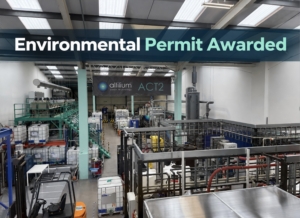
Altilium has been granted a bespoke environmental permit by the Environment Agency for its ACT 2 facility in Plymouth, marking an important milestone in the development of the UK’s domestic battery recycling industry.
The bespoke permit provides the regulatory framework for ACT 2 to operate Altilium’s EcoCathode™ and EcoAnode™ hydrometallurgical processes. The facility is designed to recover critical battery materials from EV battery black mass, processing material equivalent to approximately one EV battery per day through to high-value anode active material (AAM) and cathode active material (CAM).
The permit is the first to be issued in the UK for the hydrometallurgical recovery of EV battery black mass at this scale.
More than two years of regulatory assessment and technical engagement have gone into reaching this milestone. Developing the regulatory framework and demonstrating compliance with environmental requirements are essential steps in scaling innovative battery recycling technologies and establishing new industrial processes in the UK.
Prior to receiving the full environmental permit, ACT 2 operated under a Local Enforcement Position (LEP), providing a period of controlled operation and regulatory oversight as Altilium progressed towards full permitting.
The environmental permit is an important step in establishing the industrial, regulatory and technical foundations required to develop a UK circular battery economy. It supports Altilium’s ambition to recover critical battery materials domestically and return them to the UK battery supply chain.
Today, UK-generated battery black mass is exported overseas for further processing, meaning that valuable critical minerals and associated economic value leave the UK before processed materials are subsequently imported back into the supply chain.
Altilium would like to thank the Environment Agency and all stakeholders, technical teams and advisers involved in the extensive assessment and engagement process that has supported the award of the permit.
Get in touch
Building the recycling infrastructure needed for net-zero requires a collaborative approach.